
Like most couples, Stacy and Mitch Brookhyser dreamed of their future with children. They hoped the child would share their love of music and imagined the day when Mitch would first teach the child how to surf. But more that anything they hoped their child would simply be healthy, but for the Brookhyser’s there was a 50 percent chance that wouldn’t happen.
Huntington’s Disease ran rampant in Stacy’s family; she had seen it affect her grandma, mother and aunt, and she knew if she shared the same gene mutation and passed it down, her children would face the same fate.
Genetics 101 tells us that if both parents have brown eyes, it is unlikely to have a child without brown eyes. Brown is a dominant gene, we’ve known this since high school. What most people don’t know is that disease can also be dominant- Huntington’s is. A genetic test revealed that Stacy was carrying the gene.
Stacy decided it was time once and for all to prune Huntington’s disease out of her family tree using a revolutionary process called Premplantation Genetic Diagnosis. (PGD).
“We didn’t want to just plunge ahead and have kids; we felt that wasn’t responsible,” Stacy say. “ It was difficult to deal with the results of the news, but we were still driven to have kids.”
 Expectant couples may hope for a certain hair and eye color, and certain facial features, but the most important thing is a clean bill of health and until recently this basic desire was an uncertainty for couples with a family history of disease. Getting pregnant was quite literally a roll of the genetic dice. But thanks to improvements in PGD, these high- risk couples can virtually assure a disease-free child.
PGD was developed in the 1980’s and the first successful live births using the technology occurred in 1989.
“PGD came out of pure frustration,” say Dr. Mark Hughes, of the Genesis Genetics Institute and one of the doctors who developed the technology. “I got tired of having to meet with couples who just had a baby with a horrible disease and explain to them how it happened and that their future children had a 25 percent chance of having the same disorder.”
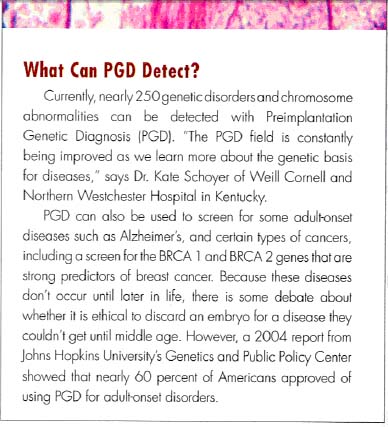
Initially, PGD screened only for cystic fibrosis, but today more than 240 diseases can be checked.
The Brookhyser’s turned to Lawrence Werlin of the Coastal Fertility Medical Center in Orange County, CA.
It makes a huge difference if you have a great doctor with a great lab., “ says Stacy. “Dr. Werlin made a difficult process comfortable for us.”
PGD involves testing embryos for genetic mutations or chromosomal defects before using IVF to implant them in the womb. Doctors in Europe, and now some in the United States, are starting to separate the two types of testing, referring to chromosome screening as Preimplantation Genetic Screening (PGS) and leaving PGD to cover genetic mutations. The idea is that because chromosome abnormalities are random, a single test can be used to screen any in-vitro patient, whereas a genetic mutation is specific to each family and individualized tests must be constructed. A recent study in the journal Fertility and Sterility showed that 20 percent of IVF patients used PGD in 2005, with two-thirds testing for chromosome problems and 12 percent testing for genetic mutations.
Surprisingly, a abnormality in one of the 23 pairs of chromosomes humans carry is not uncommon. A study using embryos from the Huntington Reproductive Center in Pasadena, CA, analyzed 289 embryos from 22 egg donors and found chromosomal abnormalities in 42 percent. PGS allows doctors to determine if an embryo has too few or too many chromosomes. Currently 80 percent of all defects can be caught.
While chromosomal abnormalities are a fluke, genetic mutations are the results of the parents carrying a recessive , dominant or X-linked flawed gene. In a dominant disorder, like Huntington’s disease, if one parent has a defective gene that dominates its natural counterpart, it leaves their offspring with a 50 percent chance of developing the disease. In recessive disorders, like cystic fibrosis, if both parents carry one defective gene and a normal counterpart, their offspring have a 50 percent chance of being a carrier and a 25 percent chance of contracting the disease.
“People don’t come in for PGD for trivial diseases,” says Hughes, “They’ve made a conscious decision to prune a disease out of the family tree forever.”
The first step in PGD is to test the parents to see if they carry any defective genes that could get passed along to the child. In many cases, a family history lets doctors know what they’re looking for, but other times, a couple will test simply because their ethnicity is a predisposition to certain diseases. If the parent’s blood test indicates any genetic mutations, DNA samples are taken from the couple and any family members who may already have had the disease. This allows doctors to craft a test specific to the family’s particular mutation to screen the embryos.
Expectant couples may hope for a certain hair and eye color, and certain facial features, but the most important thing is a clean bill of health and until recently this basic desire was an uncertainty for couples with a family history of disease. Getting pregnant was quite literally a roll of the genetic dice. But thanks to improvements in PGD, these high- risk couples can virtually assure a disease-free child.
PGD was developed in the 1980’s and the first successful live births using the technology occurred in 1989.
“PGD came out of pure frustration,” say Dr. Mark Hughes, of the Genesis Genetics Institute and one of the doctors who developed the technology. “I got tired of having to meet with couples who just had a baby with a horrible disease and explain to them how it happened and that their future children had a 25 percent chance of having the same disorder.”
Initially, PGD screened only for cystic fibrosis, but today more than 240 diseases can be checked.
The Brookhyser’s turned to Lawrence Werlin of the Coastal Fertility Medical Center in Orange County, CA.
It makes a huge difference if you have a great doctor with a great lab., “ says Stacy. “Dr. Werlin made a difficult process comfortable for us.”
PGD involves testing embryos for genetic mutations or chromosomal defects before using IVF to implant them in the womb. Doctors in Europe, and now some in the United States, are starting to separate the two types of testing, referring to chromosome screening as Preimplantation Genetic Screening (PGS) and leaving PGD to cover genetic mutations. The idea is that because chromosome abnormalities are random, a single test can be used to screen any in-vitro patient, whereas a genetic mutation is specific to each family and individualized tests must be constructed. A recent study in the journal Fertility and Sterility showed that 20 percent of IVF patients used PGD in 2005, with two-thirds testing for chromosome problems and 12 percent testing for genetic mutations.
Surprisingly, a abnormality in one of the 23 pairs of chromosomes humans carry is not uncommon. A study using embryos from the Huntington Reproductive Center in Pasadena, CA, analyzed 289 embryos from 22 egg donors and found chromosomal abnormalities in 42 percent. PGS allows doctors to determine if an embryo has too few or too many chromosomes. Currently 80 percent of all defects can be caught.
While chromosomal abnormalities are a fluke, genetic mutations are the results of the parents carrying a recessive , dominant or X-linked flawed gene. In a dominant disorder, like Huntington’s disease, if one parent has a defective gene that dominates its natural counterpart, it leaves their offspring with a 50 percent chance of developing the disease. In recessive disorders, like cystic fibrosis, if both parents carry one defective gene and a normal counterpart, their offspring have a 50 percent chance of being a carrier and a 25 percent chance of contracting the disease.
“People don’t come in for PGD for trivial diseases,” says Hughes, “They’ve made a conscious decision to prune a disease out of the family tree forever.”
The first step in PGD is to test the parents to see if they carry any defective genes that could get passed along to the child. In many cases, a family history lets doctors know what they’re looking for, but other times, a couple will test simply because their ethnicity is a predisposition to certain diseases. If the parent’s blood test indicates any genetic mutations, DNA samples are taken from the couple and any family members who may already have had the disease. This allows doctors to craft a test specific to the family’s particular mutation to screen the embryos.


 Expectant couples may hope for a certain hair and eye color, and certain facial features, but the most important thing is a clean bill of health and until recently this basic desire was an uncertainty for couples with a family history of disease. Getting pregnant was quite literally a roll of the genetic dice. But thanks to improvements in PGD, these high- risk couples can virtually assure a disease-free child.
PGD was developed in the 1980’s and the first successful live births using the technology occurred in 1989.
“PGD came out of pure frustration,” say Dr. Mark Hughes, of the Genesis Genetics Institute and one of the doctors who developed the technology. “I got tired of having to meet with couples who just had a baby with a horrible disease and explain to them how it happened and that their future children had a 25 percent chance of having the same disorder.”
Initially, PGD screened only for cystic fibrosis, but today more than 240 diseases can be checked.
The Brookhyser’s turned to Lawrence Werlin of the Coastal Fertility Medical Center in Orange County, CA.
It makes a huge difference if you have a great doctor with a great lab., “ says Stacy. “Dr. Werlin made a difficult process comfortable for us.”
PGD involves testing embryos for genetic mutations or chromosomal defects before using IVF to implant them in the womb. Doctors in Europe, and now some in the United States, are starting to separate the two types of testing, referring to chromosome screening as Preimplantation Genetic Screening (PGS) and leaving PGD to cover genetic mutations. The idea is that because chromosome abnormalities are random, a single test can be used to screen any in-vitro patient, whereas a genetic mutation is specific to each family and individualized tests must be constructed. A recent study in the journal Fertility and Sterility showed that 20 percent of IVF patients used PGD in 2005, with two-thirds testing for chromosome problems and 12 percent testing for genetic mutations.
Surprisingly, a abnormality in one of the 23 pairs of chromosomes humans carry is not uncommon. A study using embryos from the Huntington Reproductive Center in Pasadena, CA, analyzed 289 embryos from 22 egg donors and found chromosomal abnormalities in 42 percent. PGS allows doctors to determine if an embryo has too few or too many chromosomes. Currently 80 percent of all defects can be caught.
While chromosomal abnormalities are a fluke, genetic mutations are the results of the parents carrying a recessive , dominant or X-linked flawed gene. In a dominant disorder, like Huntington’s disease, if one parent has a defective gene that dominates its natural counterpart, it leaves their offspring with a 50 percent chance of developing the disease. In recessive disorders, like cystic fibrosis, if both parents carry one defective gene and a normal counterpart, their offspring have a 50 percent chance of being a carrier and a 25 percent chance of contracting the disease.
“People don’t come in for PGD for trivial diseases,” says Hughes, “They’ve made a conscious decision to prune a disease out of the family tree forever.”
The first step in PGD is to test the parents to see if they carry any defective genes that could get passed along to the child. In many cases, a family history lets doctors know what they’re looking for, but other times, a couple will test simply because their ethnicity is a predisposition to certain diseases. If the parent’s blood test indicates any genetic mutations, DNA samples are taken from the couple and any family members who may already have had the disease. This allows doctors to craft a test specific to the family’s particular mutation to screen the embryos.
Expectant couples may hope for a certain hair and eye color, and certain facial features, but the most important thing is a clean bill of health and until recently this basic desire was an uncertainty for couples with a family history of disease. Getting pregnant was quite literally a roll of the genetic dice. But thanks to improvements in PGD, these high- risk couples can virtually assure a disease-free child.
PGD was developed in the 1980’s and the first successful live births using the technology occurred in 1989.
“PGD came out of pure frustration,” say Dr. Mark Hughes, of the Genesis Genetics Institute and one of the doctors who developed the technology. “I got tired of having to meet with couples who just had a baby with a horrible disease and explain to them how it happened and that their future children had a 25 percent chance of having the same disorder.”
Initially, PGD screened only for cystic fibrosis, but today more than 240 diseases can be checked.
The Brookhyser’s turned to Lawrence Werlin of the Coastal Fertility Medical Center in Orange County, CA.
It makes a huge difference if you have a great doctor with a great lab., “ says Stacy. “Dr. Werlin made a difficult process comfortable for us.”
PGD involves testing embryos for genetic mutations or chromosomal defects before using IVF to implant them in the womb. Doctors in Europe, and now some in the United States, are starting to separate the two types of testing, referring to chromosome screening as Preimplantation Genetic Screening (PGS) and leaving PGD to cover genetic mutations. The idea is that because chromosome abnormalities are random, a single test can be used to screen any in-vitro patient, whereas a genetic mutation is specific to each family and individualized tests must be constructed. A recent study in the journal Fertility and Sterility showed that 20 percent of IVF patients used PGD in 2005, with two-thirds testing for chromosome problems and 12 percent testing for genetic mutations.
Surprisingly, a abnormality in one of the 23 pairs of chromosomes humans carry is not uncommon. A study using embryos from the Huntington Reproductive Center in Pasadena, CA, analyzed 289 embryos from 22 egg donors and found chromosomal abnormalities in 42 percent. PGS allows doctors to determine if an embryo has too few or too many chromosomes. Currently 80 percent of all defects can be caught.
While chromosomal abnormalities are a fluke, genetic mutations are the results of the parents carrying a recessive , dominant or X-linked flawed gene. In a dominant disorder, like Huntington’s disease, if one parent has a defective gene that dominates its natural counterpart, it leaves their offspring with a 50 percent chance of developing the disease. In recessive disorders, like cystic fibrosis, if both parents carry one defective gene and a normal counterpart, their offspring have a 50 percent chance of being a carrier and a 25 percent chance of contracting the disease.
“People don’t come in for PGD for trivial diseases,” says Hughes, “They’ve made a conscious decision to prune a disease out of the family tree forever.”
The first step in PGD is to test the parents to see if they carry any defective genes that could get passed along to the child. In many cases, a family history lets doctors know what they’re looking for, but other times, a couple will test simply because their ethnicity is a predisposition to certain diseases. If the parent’s blood test indicates any genetic mutations, DNA samples are taken from the couple and any family members who may already have had the disease. This allows doctors to craft a test specific to the family’s particular mutation to screen the embryos.
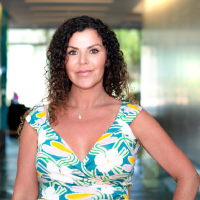
Julianna Nikolic
Chief Strategy Officer Julianna Nikolic leads strategic initiatives, focusing on growth, innovation, and patient-centered solutions in the reproductive sciences sector. With 26+ years of management experience and a strong entrepreneurial background, she brings deep expertise to advancing reproductive healthcare.



 Make a Payment