

Watch Our On-Demand Fertility Seminars!
Different Topics Available

Coastal Fertility Blog

IVF Timeline: How Long Does IVF Take From Start to Finish?

IVF cycle timeline

A complete IVF cycle takes approximately 4-6 weeks from the start of stimulation to embryo transfer.

Including pre-cycle preparation and testing, most patients should plan for 2-3 months from first consultation to pregnancy test. If you are doing IVF with preimplantation genetic testing (PGT), add another 2-4 weeks for biopsy results.

That’s the short answer. The longer answer – the one that helps you actually prepare – is what this guide is for.

It walks you through each stage exactly as we explain it in our clinic: clinically precise, practically grounded, and always honest about what to expect.


Key Takeaways

Total Duration: Active treatment takes 4 to 6 weeks, while the full journey from initial testing to graduating back to your OB/GYN spans 3 to 5 months.
Preparation: Includes taking birth control and simple clinic checks (like a mock transfer) to ensure your uterus is fully ready.
Monitoring: Involves routine, quick blood tests and ultrasounds on Days 1, 3, 5, and 7 of your daily injections.
Egg Retrieval: A quick, 20-to-30-minute outpatient procedure performed while you are comfortably asleep under light sedation.
Embryo Growth: Fertilized eggs grow in our lab for 5 to 6 days. Genetic screening (PGT), if selected, adds about 2 to 4 weeks.
Early Pregnancy Support: We monitor you closely after transfer with two blood tests and two early ultrasounds until you graduate back to your doctor.

IVF Timeline at a Glance

The table below shows the full IVF process timeline from first consultation to pregnancy test. 

Every phase has a typical duration – though your personalised calendar will depend on your protocol, your body’s response, and whether you’re doing a fresh or frozen transfer.

Phase
Typical Duration
Phase 1: Initial consultation and pre-cycle testing
2-4 weeks
Phase 2: Pre-cycle preparation (OCP priming + program start)
3-7 weeks
Phase 3: Ovarian stimulation
8-12 days
Phase 4: Trigger shot and egg retrieval
36 hours + 1 day
Phase 5: Fertilisation and embryo development
3-6 days
Phase 6: Embryo transfer
1 day
Phase 7: Post-transfer monitoring and pregnancy confirmation
6-10 weeks
Total: First consultation to Ob/Gyn referral
3-5 months

If you are proceeding with a frozen embryo transfer (FET) rather than a fresh transfer, add approximately 4–6 weeks for a separate FET cycle. If you are doing IVF with PGT, add 2–4 weeks for genetic biopsy results before transfer.

Have questions about how this timeline applies to your specific situation?

Phase 1: Initial Consultation and Pre-Cycle Testing (2–4 weeks)

Meeting Your Fertility Specialist
Your IVF journey begins with a consultation with one of our reproductive endocrinologists. This is not a brief intake appointment – it’s a thorough clinical conversation covering your reproductive history, any previous fertility treatments, your diagnosis (if one has been established), and your goals.
For same-sex partners and single intended parents, this appointment also covers donor coordination, carrier screening, and any additional considerations specific to your path.
At the end of your consultation, you’ll leave with a clear picture of your recommended protocol and a realistic, personalised timeline.
Pre-Cycle Tests for Female Patients
Before stimulation begins, your physician needs a complete picture of your ovarian reserve and overall reproductive health.
Test
What It Measures
Anti-Müllerian hormone (AMH)
Ovarian reserve – how many eggs remain
Antral follicle count (AFC) ultrasound
Resting follicles visible on transvaginal ultrasound
Day 3 FSH and estradiol
Baseline hormonal status
Thyroid-stimulating hormone (TSH)
Thyroid function, which affects fertility and pregnancy
Prolactin
Elevated levels can interfere with ovulation
Complete blood count (CBC)
General health screen
Pap smear (if not current)
Cervical health
Infectious disease panel
Hepatitis B and C, HIV, RPR (syphilis) – required by FDA
Uterine cavity evaluation
Saline infusion sonohysterogram (SIS) or hysteroscopy to assess the uterine lining for polyps, fibroids, or structural concerns
Your AMH and AFC results together give us a detailed picture of your expected response to stimulation – and are central to designing your medication protocol.
Pre-Cycle Tests for Male Patients
For male patients, or for patients using a known sperm donor, pre-cycle testing includes:
Test
What It Measures
Sperm count, motility, and morphology
Sperm DNA fragmentation (if indicated)
DNA integrity, which affects fertilisation and embryo quality
Infectious disease panel
Hepatitis B and C, HIV, RPR – FDA-required for sperm used in IVF
If the semen analysis reveals concerns about count, motility, or morphology, your physician may recommend IVF with ICSI (intracytoplasmic sperm injection) to maximise fertilisation rates.
Once testing is complete, your physician will build your personalised IVF protocol. Most patients begin their active cycle within 2-4 weeks of their initial testing.

Phase 2: Pre-Cycle Preparation (3-7 weeks)

Pre-cycle preparation at Coastal Fertility follows a structured three-stage sequence. Understanding this sequence helps patients know exactly what to expect – and why each step exists – before stimulation begins.
1
Stage 1: Initial OCP Priming (3 days – 3 weeks)
It may seem counterintuitive to take birth control pills at the start of an IVF cycle. But oral contraceptive pill (OCP) priming serves an important clinical purpose: it synchronises your follicle development, gives your care team precise control over your cycle start date, and helps prevent the early development of a dominant follicle before stimulation begins.
This first OCP phase typically runs for 3 days to 3 weeks, depending on where you are in your natural cycle when you start and how your schedule aligns with the clinic’s laboratory calendar.
2
Stage 2: Program Start (1 week – 1 month)
After the initial OCP phase, you will come in for your Program Start appointment – one of the most important visits before stimulation begins. This appointment typically includes:
Consent signing
reviewing and signing your IVF consent documentation with your physician
Trial (mock) transfer
a practice run of the embryo transfer procedure, performed without an embryo, to map the length and angle of your cervical canal. This allows your physician to plan the actual transfer and minimise any technical difficulty on transfer day
Sonohysterogram (SIS)
a saline infusion ultrasound that provides a final, detailed view of the uterine cavity to rule out polyps, fibroids, or fluid that could affect implantation
This Program Start phase takes 1 week to 1 month to schedule and complete, depending on where you are in your cycle and your personal schedule.
3
Stage 3: OCP Re-Start (7–14 days)
Following your Program Start appointment, OCPs are restarted for a final 7-14 day priming period before your baseline ultrasound and the start of stimulation. This second OCP phase fine-tunes cycle synchronisation and gives the clinical team a predictable, controlled window to begin your injections.
For patients following a long Lupron (GnRH agonist) protocol, leuprolide acetate (Lupron) injections begin on approximately Day 21 of the preceding cycle – typically overlapping with the end of the second OCP phase. Lupron suppresses premature LH release for approximately 10 days before stimulation begins, and is followed by a suppression check ultrasound to confirm your ovaries are quiet and your estradiol is appropriately low.
Not every patient follows the long Lupron protocol. Many patients at CFMC use an antagonist protocol, in which a GnRH antagonist (cetrorelix or ganirelix) is introduced only after stimulation is underway. Your physician will recommend the protocol best suited to your ovarian reserve, response history, and individual circumstances.
For a complete overview of IVF medications – including what each injection does and how to administer them – see our IVF medications guide.

Phase 3: Ovarian Stimulation (8-12 days)

Ovarian stimulation is the phase most patients think of when they picture IVF – the daily injections, the monitoring appointments, the sense that something significant is happening.
Stimulation begins on Day 2 or Day 3 of your cycle (the first day of full flow is Day 1). Your physician will prescribe gonadotropin injections – follicle-stimulating hormone (FSH) medications such as follitropin alfa (Gonal-F), follitropin beta (Follistim), or a combination product – to stimulate your ovaries to develop multiple follicles simultaneously.
The goal is controlled ovarian hyperstimulation: encouraging more follicles to mature than would develop in a natural cycle, without overstimulating the ovaries to the point of causing ovarian hyperstimulation syndrome (OHSS).
Your Monitoring Schedule During Stimulation
At CFMC, stimulation monitoring follows a structured day-by-day schedule. Knowing this schedule in advance helps patients plan around appointments and removes the uncertainty of not knowing when they’ll next be in the clinic.
Stimulation Day
What Happens at Your Appointment
Day 1
Baseline transvaginal ultrasound + blood draw (estradiol, LH) – confirms ovaries are quiet and stimulation can begin
Day 3
Blood draw only – estradiol check to confirm follicles are responding
Day 5
Ultrasound + blood draw – follicle count and sizing; dose adjustments made if needed
Day 7
Ultrasound + blood draw – follicle growth assessment; GnRH antagonist may be added at this stage (antagonist protocol)
Days 8–12
Daily individualised monitoring – ultrasound and/or blood draw each day until lead follicles reach 18-20 mm; trigger shot timing confirmed
Your physician will review every set of results and adjust your medication doses in real time. This is not a fixed protocol that runs on autopilot – it’s an active, responsive process that adapts to how your ovaries are responding day by day.
Stimulation typically concludes in 8-12 days, once your lead follicles have reached approximately 18-20 mm in diameter and your estradiol levels confirm egg maturity.

Phase 4: The Trigger Shot and Egg Retrieval (36 hours + 1 day)

The Trigger Shot
When your monitoring results confirm that enough follicles have reached target size, your physician will give you precise instructions for administering the trigger shot – a final injection that completes the maturation process of your eggs.
The trigger shot is typically human chorionic gonadotropin (hCG), such as choriogonadotropin alfa (Ovidrel), or in some cases a GnRH agonist trigger. The timing is critical: egg retrieval is scheduled exactly 36 hours after the trigger injection. The trigger must be administered at the precisely specified hour – not earlier, not later.
Egg Retrieval
Egg retrieval is a brief outpatient procedure performed under IV sedation – you will be comfortable and unaware during the process. A transvaginal ultrasound probe guides a thin aspiration needle through the vaginal wall into each ovarian follicle, and the follicular fluid – containing the eggs – is gently suctioned out.
The procedure itself takes approximately 20-30 minutes. You will spend another 1-2 hours in recovery before being discharged, and you will need someone to drive you home.
The number of eggs retrieved depends on your ovarian reserve, your age, and how you respond to stimulation. Our embryology team will notify you of your egg count on the day of retrieval, and will update you each day as your embryos develop.

Phase 5: Fertilisation and Embryo Development (3–6 days)

Laboratory Timeline & Observations
Day 0 Egg and Sperm Are Combined
On the day of egg retrieval (Day 0), your eggs are assessed for maturity in the embryology laboratory. Mature eggs are fertilised either by conventional insemination – where sperm are placed in a dish with the eggs – or by ICSI (intracytoplasmic sperm injection), where a single sperm is injected directly into each mature egg. ICSI is recommended when sperm parameters are abnormal, when there are concerns about fertilisation rates, or when eggs or sperm have been frozen.
Day 1 Fertilisation Check
The morning after retrieval, the laboratory checks which eggs have fertilised successfully. A normally fertilised egg – called a 2PN (two pronuclei) embryo – will have two visible pronuclei, one from the egg and one from the sperm. Fertilisation rates typically range from 60-80% of mature eggs.
Days 3-6 Embryo Monitoring and Grading
Embryos are cultured in our laboratory incubators and observed closely as they divide and develop. At CFMC, embryos are typically cultured to the blastocyst stage – Day 5 or Day 6 of development.
A blastocyst is a more advanced embryo structure consisting of approximately 100-200 cells organised into two distinct cell types: the inner cell mass (which becomes the baby) and the trophectoderm (which becomes the placenta). Blastocyst-stage transfer is associated with higher implantation rates compared to Day 3 transfers, which is why most programmes prefer culturing to this stage when possible.
Embryos that reach the blastocyst stage are graded based on their expansion, inner cell mass quality, and trophectoderm quality. Your physician will discuss your embryo grades and how they inform the transfer recommendation.

Fresh vs. Frozen Transfer Decision

At the end of the development phase, your care team will determine whether to proceed with a fresh embryo transfer (within the same cycle, 5-6 days after retrieval) or to freeze all embryos for a subsequent frozen embryo transfer (FET) cycle.
A freeze-all approach is recommended in a number of situations: if your progesterone was elevated near the end of stimulation, if you showed signs of OHSS risk, if PGT is being performed, or if your uterine lining was not considered optimal during the stimulation cycle.

Phase 6: Embryo Transfer (1 day)

Fresh Embryo Transfer
In a fresh transfer, one embryo is placed in the uterus on Day 3 or Day 5 after egg retrieval – most commonly Day 5, when the embryo has reached the blastocyst stage. The embryo transfer procedure itself is simple: a thin, flexible catheter is guided through the cervix into the uterine cavity under ultrasound guidance, and the embryo is gently deposited. No anaesthesia is required. Most patients describe it as similar to a Pap smear. The procedure takes approximately 10-15 minutes.
You will rest briefly in our recovery area and then return home. Most patients resume light activity the same day.
Frozen Embryo Transfer (FET)
A frozen embryo transfer takes place in a separate cycle, approximately 4-6 weeks after the egg retrieval cycle. During a FET cycle, you will take oestrogen supplementation to develop and thicken the uterine lining, followed by progesterone to prepare the endometrium for implantation. Your lining is monitored with ultrasound and bloodwork before a transfer date is confirmed.
The FET procedure itself is identical to a fresh transfer – a catheter, ultrasound guidance, no anaesthesia, approximately 10-15 minutes.

Phase 7: Post-Transfer Monitoring and Pregnancy Confirmation (6-10 weeks)

For many patients, the journey after embryo transfer is the least-understood part of the IVF timeline – and one of the most important. At CFMC, we don’t send you home after the transfer and ask you to wait alone. What follows is a structured, closely supported medical sequence that takes you all the way through to confirmed pregnancy and your referral back to your Ob/Gyn.
The Clinical Monitoring Sequence
The Transfer Aftermath The Two-Week Wait
The two-week wait – the period between embryo transfer and your first pregnancy test — is genuinely the most emotionally demanding part of the IVF cycle timeline for most patients. You will continue progesterone supplementation (injections, vaginal suppositories, or both) throughout this period to support the uterine lining. Home pregnancy tests are not recommended – they can give misleading results while you are on hormonal support medications.
10–12 Days Post-Transfer 1st BHCG Blood Draw
Exactly 10 to 12 days after your embryo transfer, you will come to our Irvine clinic for your first BHCG (beta hCG) blood draw – a quantitative blood test that measures your actual hCG level, not just a positive or negative. This precision matters: a specific number tells your physician far more than a home test result.
2–4 Days Later 2nd BHCG Confirmation
If your first BHCG is positive, a second BHCG is scheduled 2 to 4 days later. This follow-up confirms that your hCG is rising appropriately – a doubling pattern every 48-72 hours is a strong early indicator of a healthy, developing pregnancy. If the first BHCG is negative, your team will review the cycle with you and discuss next steps.
1–3 Weeks Later 1st COP Scan
Once rising hCG levels are confirmed, your physician will schedule your first COP (Clinical Obstetric Pregnancy) scan – an early ultrasound performed approximately 1 to 3 weeks after your second BHCG. This scan confirms the location of the pregnancy (ruling out ectopic implantation), visualises the gestational sac, and, depending on timing, may detect early cardiac activity.
2 Weeks Later 2nd COP Scan
Your second COP scan follows approximately 2 weeks later. By this point, cardiac activity is typically well-established and visible. This scan gives your physician a clear picture of early foetal development and ensures everything is progressing on track before the final step.
Referral Back to Your Ob/Gyn
After your second COP scan confirms a healthy, progressing pregnancy, CFMC will warmly refer you back to your personal Ob/Gyn for ongoing prenatal care. You will leave our care with a complete clinical summary, your early scan images, and the full support of a team that has been with you through every step of this journey.
If the first transfer does not result in a pregnancy, that does not mean IVF won’t work for you. It means your team will review the cycle carefully, adjust the protocol where indicated, and support you through whatever comes next. Your IVF success rates and what to realistically expect across multiple cycles are part of the conversation we have with you from your very first consultation.

What Affects Your IVF Timeline?

No two IVF timelines are identical. The following factors can shorten, lengthen, or alter the sequence of your personalised IVF cycle timeline:
01
Age and ovarian reserve. Patients with lower ovarian reserve may require longer or more intensive stimulation, or may have fewer embryos available for transfer or freezing. Success rates also vary meaningfully by age.
02
Protocol type. The long Lupron (GnRH agonist) protocol adds a 2-4 week suppression phase before stimulation begins. The antagonist protocol is shorter, introducing suppression medication only once stimulation is underway.
03
Fresh vs. frozen transfer. A fresh transfer adds no extra time to the stimulation cycle. A frozen embryo transfer requires a separate 4-6 week cycle.
04
PGT testing. Preimplantation genetic testing adds approximately 2-4 weeks to the IVF process timeframe – biopsy results must be returned before a transfer can be scheduled. All PGT cycles require a frozen transfer.

What Affects Your IVF Timeline?

No two IVF timelines are identical. The following factors can shorten, lengthen, or alter the sequence of your personalised IVF cycle timeline:
01
Age and ovarian reserve. Patients with lower ovarian reserve may require longer or more intensive stimulation, or may have fewer embryos available for transfer or freezing. Success rates also vary meaningfully by age.
02
Protocol type. The long Lupron (GnRH agonist) protocol adds a 2-4 week suppression phase before stimulation begins. The antagonist protocol is shorter, introducing suppression medication only once stimulation is underway.
03
Fresh vs. frozen transfer. A fresh transfer adds no extra time to the stimulation cycle. A frozen embryo transfer requires a separate 4-6 week cycle.
04
PGT testing. Preimplantation genetic testing adds approximately 2-4 weeks to the IVF process timeframe – biopsy results must be returned before a transfer can be scheduled. All PGT cycles require a frozen transfer.
05
Response to stimulation. If your ovaries respond slowly or incompletely to medication, stimulation may be extended or the cycle may be cancelled and restarted with a modified protocol.
06
Cancelled cycles. Occasionally, a cycle is cancelled before retrieval – due to poor response, elevated progesterone, or an unforeseen finding – and restarted. This adds a full additional cycle to your timeline.
07
Uterine factors. If your suppression check or lining assessment identifies a polyp, fibroid, or fluid in the uterine cavity, a minor procedure may be recommended before transfer – adding additional weeks to the IVF process and timeline.

Sample IVF Timeline Calendar

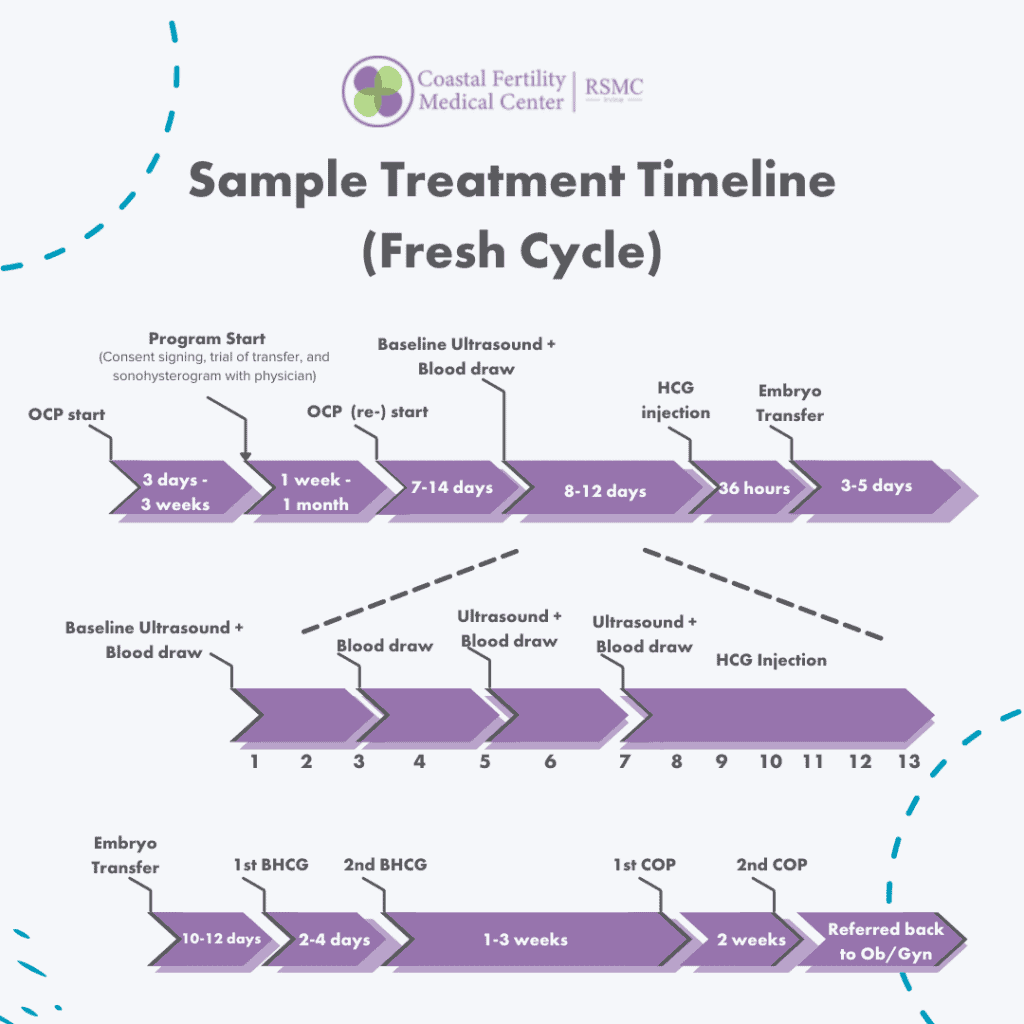
The table below shows a complete fresh cycle at CFMC – from OCP priming through to your Ob/Gyn referral. Your actual calendar will be personalised by your physician, but this gives you a concrete, day-by-day picture of what an IVF schedule looks like from start to finish.
Stage / Day
What’s Happening
Pre-Cycle: Stage 1
OCP priming begins (3 days – 3 weeks)
Pre-Cycle: Stage 2
Program Start: consent signing, trial transfer, sonohysterogram (1 week – 1 month)
Pre-Cycle: Stage 3
OCP re-start (7-14 days); Lupron begins Day 21 if on long protocol
Stimulation Day 1
Baseline ultrasound + blood draw; gonadotropin injections begin
Stimulation Day 3
Blood draw only – estradiol check
Stimulation Day 5
Ultrasound + blood draw – follicle sizing; dose adjusted if needed
Stimulation Day 7
Ultrasound + blood draw – follicle growth; antagonist added if applicable
Stimulation Days 8-12
Daily monitoring (ultrasound ± blood draw) until lead follicles reach 18-20 mm
Day 11-13 (approx.)
Trigger shot administered at precisely specified hour
36 hours post-trigger
Egg retrieval – outpatient, IV sedation, ~20-30 minutes
Day 0 (retrieval day)
Eggs fertilised in laboratory (conventional IVF or ICSI)
Day 1
Fertilisation check: 2PN embryos confirmed
Days 3-4
Embryo monitoring: compacting morula stage
Days 5-6
Blastocyst stage: grading and biopsy (if PGT)
Day 5-6 (fresh transfer)
Embryo transfer – catheter procedure, ~10-15 minutes, no anaesthesia
10-12 days post-transfer
1st BHCG blood draw
2-4 days after 1st BHCG
2nd BHCG – confirms appropriate hCG rise
1-3 weeks after 2nd BHCG
1st COP scan – confirms pregnancy location and early development
2 weeks after 1st COP
2nd COP scan – confirms cardiac activity and foetal progression
After 2nd COP
Referred back to your personal Ob/Gyn for prenatal care
For a frozen embryo transfer cycle, the FET calendar begins after either a rest month or PGT results are returned. The FET cycle itself runs approximately 4-6 weeks before transfer, followed by the same post-transfer monitoring sequence above.

IVF Timeline With PGT (Preimplantation Genetic Testing)

Preimplantation genetic testing (PGT) – sometimes called PGS (preimplantation genetic screening) – is the analysis of embryo cells for chromosomal abnormalities before transfer. It is the single most significant factor that extends the IVF cycle timeline.
Here is how PGT changes the IVF process timeframe:
01
After blastocysts develop (Day 5-6), a small number of cells are biopsied from the trophectoderm of each embryo
02
All embryos are immediately vitrified (frozen) – no fresh transfer is possible in a PGT cycle
03
Biopsy samples are sent to a genetic laboratory; results return in approximately 2-4 weeks
04
Once results are available, a frozen embryo transfer cycle is scheduled – adding another 4-6 weeks
Time Comparison Impact
Total added time for a PGT cycle vs. a standard cycle:
approximately 6-10 weeks.
PGT is recommended for patients with a history of recurrent miscarriage, patients with a known chromosomal translocation, patients of advanced maternal age, or anyone who wishes to maximise confidence in the chromosomal status of transferred embryos before proceeding.

How Many IVF Cycles Might You Need?

Clinical Insight
This is one of the most important – and most honestly answered – questions in fertility care.
A single IVF cycle does not always result in a pregnancy. Success rates vary meaningfully by age, ovarian reserve, embryo quality, and the reason for infertility. Patients in their early 30s may have strong outcomes in one cycle. Patients in their late 30s or early 40s may benefit from multiple cycles to accumulate euploid embryos.

Thinking in Cumulative Metrics

Most fertility specialists recommend thinking about IVF in terms of cumulative success — the probability of achieving a live birth across 2-3 complete cycles – rather than a single cycle outcome. Many patients who do not conceive on the first transfer succeed on a second or third.
The CFMC Patient Continuity Blueprint
The Coastal Fertility team reviews every cycle – what worked, what didn’t, and what protocol adjustments make sense before the next attempt. You will never be left wondering what the plan is.

Insurance Coverage for IVF in California

California’s Senate Bill 729 (SB 729), effective January 1, 2026, represents the most significant expansion of fertility coverage in California’s history. For patients covered by an eligible plan, IVF treatment — including egg retrieval cycles and embryo transfers – is now a covered benefit, not an out-of-pocket expense.

What SB 729 covers (for eligible plans):

Up to 3 completed egg retrieval cycles
Unlimited embryo transfers
Infertility diagnosis and treatment, including medications directly related to covered procedures

Which plans are covered:

Fully insured, state-regulated health plans issued to employers with 101 or more employees

Key exemptions — plans NOT covered by SB 729:

Self-funded (ERISA) plans — governed by federal law, not California state law; SB 729 does not apply
Small employers (100 or fewer employees) — exempt from the mandate
CalPERS — coverage delayed until July 1, 2027
Grandfathered plans and certain religious employer plans may also be exempt
If you are unsure whether your plan qualifies, our financial coordinators will review your specific benefits, confirm your coverage status, and help you understand your out-of-pocket obligations before you begin treatment.
For a full overview of financing options and shared-risk programmes, visit our financing and insurance options page.
Coastal Fertility Medical Center 15500 Sand Canyon Avenue, Suite 100, Irvine, CA 92618  |  (949) 726-0600

Frequently Asked Questions

How long does IVF take from start to finish? +
A complete IVF cycle – from the start of ovarian stimulation to embryo transfer – takes approximately 4-6 weeks. Including the initial consultation, pre-cycle preparation (OCP priming, Program Start visit), and testing, most patients should plan for 2-3 months from first appointment to pregnancy test, and up to 3-5 months through to Ob/Gyn referral. If you are doing IVF with PGT or a frozen embryo transfer, the total timeline will be longer.
How long is the ovarian stimulation phase? +
Ovarian stimulation typically lasts 8-12 days. Monitoring follows a structured schedule: a baseline ultrasound and blood draw on Day 1, a blood draw on Day 3, ultrasound and blood draws on Days 5 and 7, then daily monitoring from Day 8 until your lead follicles reach approximately 18-20 mm and the trigger shot is given.
How many days after egg retrieval is embryo transfer? +
For a fresh transfer, the embryo is transferred on Day 3 or Day 5 after egg retrieval – most commonly Day 5, once the embryo has reached the blastocyst stage. For a frozen embryo transfer, the transfer takes place in a separate cycle beginning 4-6 weeks after retrieval; the transfer day is determined by your lining preparation.
How long does a frozen embryo transfer cycle take? +
A frozen embryo transfer (FET) cycle takes approximately 4-6 weeks from the start of oestrogen supplementation to the embryo transfer. This is in addition to the original egg retrieval cycle.
What day of your cycle do you start IVF injections? +
Gonadotropin (stimulation) injections begin on Day 2 or Day 3 of your menstrual cycle – the first day of full flow is counted as Day 1. For patients following a long Lupron protocol, suppression injections begin approximately 10 days earlier, around Day 21 of the preceding cycle.
How long does the two-week wait last, and when is the pregnancy test? +
The first beta hCG blood test (BHCG) is scheduled 10–12 days after embryo transfer — not 14 days, as the name implies. If positive, a second BHCG follows 2-4 days later to confirm the level is rising. From there, two early ultrasound scans (COP scans) take place over the following 3-5 weeks before you are referred to your Ob/Gyn.
Does IVF with PGT take longer? +
Yes. IVF with preimplantation genetic testing (PGT) adds approximately 2-4 weeks for biopsy results, plus another 4-6 weeks for the required frozen embryo transfer cycle. Total additional time vs. a standard fresh transfer cycle: approximately 6-10 weeks.
How many IVF cycles does it usually take to get pregnant? +
There is no single answer – outcomes depend on age, diagnosis, ovarian reserve, and embryo quality. Some patients conceive on their first transfer; others require two or three cycles. Most fertility specialists recommend thinking about cumulative success rates across multiple cycles rather than focusing on single-cycle statistics. Our team at Coastal Fertility will discuss realistic expectations with you based on your individual profile from your very first consultation.

Take the Next Step

Understanding the IVF timeline is one thing – taking the first step is another. Whether you are just beginning to explore IVF, are ready to schedule your initial consultation, or have questions about how the process applies to your specific situation, our team is here.

It’s worth noting that IVF is not the first step for everyone. Some patients benefit from a less intensive treatment before progressing to IVF. Your physician will recommend the path most appropriate to your circumstances, your timeline, and your goals.

At Coastal Fertility Medical Center, your care is led by a team of board-certified reproductive endocrinologists who take the time to understand your complete picture before recommending any treatment. We have guided patients through every variation of this journey — and we will be with you through every step of yours.
Coastal Fertility Medical Center 15500 Sand Canyon Avenue, Suite 100, Irvine, CA 92618  |  (949) 726-0600  |  coastalfertility.com

Julianna Nikolic

Chief Strategy Officer Julianna Nikolic leads strategic initiatives, focusing on growth, innovation, and patient-centered solutions in the reproductive sciences sector. With 26+ years of management experience and a strong entrepreneurial background, she brings deep expertise to advancing reproductive healthcare.

LinkedIn

Welcome to Coastal Fertility Family

Coastal Fertility is the leading provider of fertility solutions located in Orange County. Join us to get free updates on fertility news, treatments, infertility solutions and more.

By submitting this form, you agree to our Privacy Policy and Terms of Use and consent to receive occasional messages from CFMC.

Welcome to Coastal Fertility Family

Coastal Fertility is the leading provider of fertility solutions located in Orange County. Join us to get free updates on fertility news, treatments, infertility solutions and more.

By submitting this form, you agree to our Privacy Policy and Terms of Use and consent to receive occasional messages from CFMC.